Midwest Hardfacing
  • Roller Mill Parts
    • Rings
    • Rolls
    • Journals
    • Spiders and Supports
    • Wear Parts
  • Hammer Mill Parts
    • Pins and Rods
    • Hammers
  • Services
    • Rebuilding
    • Reverse Engineering / Custom Parts
    • Consulting
  • Used Parts
    • Used Parts Inventory
  • About Us
    • Blog
    • Careers
  • Contact
  • Menu Menu

Exploring the Different Types of Roller Mills

Roller mills have stood as the backbone of grain processing, offering precise and efficient crushing and grinding solutions for a wide range of materials. Learn more about the versatility and technology behind these essential machines in this blog.

Types of Roller Mills

The market offers a variety of roller mills, each designed to meet specific needs and challenges. Understanding the distinct features and capabilities of each type can help in selecting the right mill for your application. Before we dive deeper into the specifics of these roller mills, let’s take a high level overview of the different types of roller mills currently available.

Vertical Roller Mills

Vertical roller mills are characterized by their vertical orientation and the use of large tires to crush and grind material. These mills are known for their efficiency in grinding and separating materials within a single unit, often resulting in a finer product.

Horizontal Roller Mills

In contrast, horizontal roller mills have a horizontal orientation with the rollers placed side by side. They are commonly used for cracking or crushing coarse materials and are prized for their robust construction and longevity.

High-Pressure Roller Mills

High-pressure roller mills use two opposing rollers and high pressure to pulverize material. They are particularly effective for energy-efficient, fine and ultra-fine grinding of brittle materials.

Triple Roll Mills

Lastly, triple roll mills consist of three horizontally placed rollers rotating in opposite directions and at different speeds. This type of mill excels at dispersing pigments in viscous mediums, such as in paint and ink production.

Taking a Look at Vertical Roller Mills

Vertical roller mills are a significant innovation when it comes to different types of roller mills. They offer an alternative to traditional milling methods, providing efficiency and precision in a variety of applications. By orienting the mechanism vertically, they facilitate a smaller footprint, saving valuable floor space in production facilities.

Vertical roller mills operate with grinding rollers that move within a vertical cylinder. The grinding table, which is fixed at the base of the machine, rotates and helps to distribute the feed material evenly under the rollers. This type of mill has the advantage of being able to grind and dry materials simultaneously, reducing overall processing time.

Product Benefits When Using Vertical Roller Mills

  • Higher energy efficiency due to the vertical orientation
  • Improved product fineness and homogeneity
  • Reduction in waste and increased yield
  • Lower noise and less vibration, contributing to a better working environment
  • Less wear on the equipment due to the grinding mechanism, extending the lifespan of machine components

Common Materials Processed in Vertical Roller Mills

Vertical roller mills are versatile and can process a wide range of materials including:

  • Cement raw materials
  • Clinker and slag
  • Coal
  • Industrial minerals, such as limestone, gypsum, talc, and others

Size Reduction Mechanism Specific to Vertical Roller Mills

The mechanism of size reduction in vertical roller mills relies on the pressure and shear force applied by the rollers against the rotating grinding table. The material fed into the mill is crushed between these components. The precise control over particle size distribution makes vertical roller mills especially well-suited for producing powdered materials with a specific fineness requirement.

Looking for reliable roller mill parts or hardfacing solutions to optimize your milling operations?

Midwest Hardfacing has you covered! Explore our extensive selection of high-quality parts and accessories tailored to meet your specific needs.

Explore Our Parts

Understanding Horizontal Roller Mills

When exploring the types of roller mills used in the industry, horizontal roller mills stand out for their unique features and processing capabilities. As opposed to the more common vertical orientation, horizontal roller mills offer a different approach to grinding and processing materials.

Features of Horizontal Roller Mills

Horizontal roller mills are characterized by their distinctive horizontal arrangement of rollers. This layout provides several key features:

  • Improved particle size distribution: leads to a more uniform grind and better product quality.
  • Accessible and simple maintenance: the horizontal design tends to be easier to maintain and clean.
  • Flexibility in handling different materials: suited for a wide variety of grinding tasks.

The Grinding and Processing of Feed in Horizontal Roller Mills

In horizontal roller mills, the processing of feed involves the uniform application of pressure across the width of the rollers. This is how they effectively reduce particle size:

  • Material to be ground is fed into the horizontal chamber.
  • Rollers rotate against each other, applying sheer and compressive forces.
  • Processed material exits the mill after achieving the desired grind size.

Comparative Advantages Over Vertical Roller Mills

Horizontal roller mills are often compared with vertical roller mills, and they boast several advantages:

  • Better particle size distribution: The horizontal arrangement can lead to a more consistent grind.
  • Lower initial investments: Sometimes they are more economical when it comes to capital expenditure.
  • Flexible operation: Skilled operators can adjust horizontal mills to efficiently handle varying materials and feed sizes.

While the choice between horizontal and vertical mills depends on specific industry needs and material characteristics, horizontal roller mills certainly hold a place for their distinguishable benefits and efficient grinding capabilities.

Exploring High-Pressure Roller Mills

The high-pressure roller mills, also known as high-pressure grinding rolls (HPGR), is an advanced type of roller mill that has garnered attention for its efficiency and ability to produce uniform particle size distribution. Utilizing two counter-rotating rolls, one of which is fixed and the other floating, these mills exert high pressure on the material bed, causing fracturing and micro-cracks within the particles.

High-Pressure Grinding Technology Explained

The technology behind high-pressure roller mills involves the application of a substantial amount of pressure, which is significantly higher than that used in traditional milling. This process results in the liberation of minerals and improved leaching, especially beneficial for ores requiring fine grinding for subsequent dressing processes. Moreover, micro-cracking enhances the subsequent comminution stages, making the process more efficient.

Industrial Applications Suited for High-Pressure Mills

  • Mineral processing industries for ore preconditioning and size reduction
  • Diamond liberation
  • Pellet feed preparation
  • Industrial minerals grinding

Efficiency and Energy Consumption

High-pressure roller mills are lauded for their energy efficiency and are considered to be a more sustainable type of roller mill. Statistics show that these mills can use 20-50% less energy compared to conventional ball mills. They are designed to reduce energy consumption and operational costs, with a marked reduction in the cost per ton of material processed.

Examining Triple Roll Mills

When it comes to precision grinding and dispersing, triple roll mills are the #1 type of roller mill.

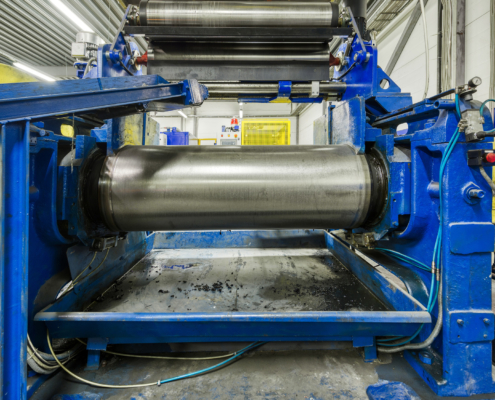
The triple roll milling process utilizes three horizontally-oriented rolls, each rotating at different speeds. This creates sheer forces necessary for the fine grinding and dispersion of materials, typically pastes, that require finely ground particles. By passing the substance through the three high-strength steel or ceramic rollers, particles are reduced to desired sizes as they are pulled through the narrow gaps between each roll.

Key Industries Utilizing Triple Roll Mills

  • Ink manufacturing
  • Paint and coating production
  • Pharmaceuticals
  • Cosmetics
  • Food processing, such as chocolate and confectionery
  • Electronics

Maintenance and Care for Triple Roll Mills

Maintenance for triple roll mills requires careful attention, as the precision of the rolls can affect the quality of the milling process. Regular cleaning to remove product residue, periodic checks to ensure rolls remain parallel, and consistent lubrication for smooth roll operation are all crucial. Moreover, inspection of the scraper mechanism and proper adjustments can mitigate premature wear and performance issues.

Triple roll mills should also undergo routine maintenance to check for potential issues such as uneven wear, hydraulic leaks, and proper alignment. By maintaining a strict care schedule, the lifespan of the equipment can be extended significantly, ensuring consistent performance and reliability in production processes.

Source Parts for Any Roller Mill With Midwest Hardfacing

At Midwest Hardfacing, we understand the importance of keeping your milling equipment running smoothly and efficiently. That’s why we offer a comprehensive range of parts and services to meet your specific requirements. Whether you’re in need of replacement parts for your roller or hammer mills, rebuilding services to extend the lifespan of your equipment, or advanced hardfacing solutions to enhance wear resistance and durability, we’re the one-stop shop for roller or hammer mill needs across the U.S.

Contact us today for all your roller mill part sourcing and hardfacing needs!

Share This Post

  • Share on Facebook
  • Share on X
  • Share on WhatsApp
  • Share on Pinterest
  • Share on LinkedIn
  • Share on Tumblr
  • Share on Vk
  • Share on Reddit
  • Share by Mail

More Like This

Why Your Mill Parts Fail Within One Year: Root Cause Analysis & Prevention Guide

Roller Mill Parts
Mill parts wearing out too fast? Learn the 6 root causes of premature mill part failure—with real plant cost data and a prevention checklist.
June 24, 2026
https://midwesthardfacing.com/wp-content/uploads/2026/06/Why-Your-Mill-Parts-Fail-Within-One-Year.jpg 1250 2000 Abstrakt Marketing /wp-content/uploads/2024/03/Midwest-Hardfacing-1.png Abstrakt Marketing2026-06-24 07:55:462026-06-24 07:58:26Why Your Mill Parts Fail Within One Year: Root Cause Analysis & Prevention Guide
A worker inspects and sorts round parts with holes

Roller Mill Rings: Complete Buyer’s Guide to Selection & Replacement

Roller Mill Parts
Complete guide to selecting and sourcing roller mill rings. Learn specifications, materials, measurement, and when to replace vs hardface.
May 7, 2026
https://midwesthardfacing.com/wp-content/uploads/2026/05/A-worker-inspects-and-sorts-round-parts-with-holes.jpg 1250 2000 Abstrakt Marketing /wp-content/uploads/2024/03/Midwest-Hardfacing-1.png Abstrakt Marketing2026-05-07 07:27:592026-05-07 07:28:03Roller Mill Rings: Complete Buyer’s Guide to Selection & Replacement
The Ins and Outs of Roller Mill Adjustments

How You Can Improve Milling Efficiency with Hardfaced Journals

Roller Mill Parts
Discover how hardfaced journals can boost your operation’s performance by enhancing milling efficiency, reducing wear, and extending roller life.
December 9, 2025
https://midwesthardfacing.com/wp-content/uploads/2024/07/The-Ins-and-Outs-of-Roller-Mill-Adjustments.jpg 1250 2000 Abstrakt Marketing /wp-content/uploads/2024/03/Midwest-Hardfacing-1.png Abstrakt Marketing2025-12-09 08:47:212026-05-04 09:19:41How You Can Improve Milling Efficiency with Hardfaced Journals

What to Look for When Buying a Used Vertical Roller Mill

Roller Mill Parts, Roller Mills
Shopping for a used vertical roller mill? Learn how to evaluate performance, wear parts, and vendor credibility to make a smart investment.
August 11, 2025
https://midwesthardfacing.com/wp-content/uploads/2025/06/IMG_0577.jpeg 2048 1536 Abstrakt Marketing /wp-content/uploads/2024/03/Midwest-Hardfacing-1.png Abstrakt Marketing2025-08-11 14:27:062026-05-04 09:19:41What to Look for When Buying a Used Vertical Roller Mill
Side view of a large mine operation

Reviewing Raymond Mill Sizes: The Basics

Roller Mill Parts
Explore the different Raymond mill sizes, their uses in industries like mining and construction, and how to select the right size.
January 7, 2025
https://midwesthardfacing.com/wp-content/uploads/2025/01/Side-view-of-a-large-mine-operation.jpg 1250 2000 Abstrakt Marketing /wp-content/uploads/2024/03/Midwest-Hardfacing-1.png Abstrakt Marketing2025-01-07 09:55:302026-05-04 09:19:43Reviewing Raymond Mill Sizes: The Basics
The Ins and Outs of Roller Mill Adjustments

Reviewing Key Roller Mill Parts for Bentonite Processing Plants

Roller Mill Parts
Discover the essential roller mill parts for bentonite processing plants, including rolls, bearings, and feeders.
December 30, 2024
https://midwesthardfacing.com/wp-content/uploads/2024/07/The-Ins-and-Outs-of-Roller-Mill-Adjustments.jpg 1250 2000 Abstrakt Marketing /wp-content/uploads/2024/03/Midwest-Hardfacing-1.png Abstrakt Marketing2024-12-30 12:51:192026-05-04 09:19:43Reviewing Key Roller Mill Parts for Bentonite Processing Plants

The Ins and Outs Of a Roller Mill’s Structure

Roller Mill Parts
Learn about roller mill structure, key components prone to wear, and how proper maintenance can optimize performance.
December 30, 2024
https://midwesthardfacing.com/wp-content/uploads/2024/05/Rollers-for-a-roller-mill.jpg 1250 2000 Abstrakt Marketing /wp-content/uploads/2024/03/Midwest-Hardfacing-1.png Abstrakt Marketing2024-12-30 12:44:532026-05-04 09:19:43The Ins and Outs Of a Roller Mill’s Structure

Williams Vs. Bradley Roller Mills: What You Need to Know

Roller Mill Parts
Discover the key differences between Williams Vs. Bradley Roller Mills. Learn how each brand’s design and application capabilities make them different.
October 25, 2024
https://midwesthardfacing.com/wp-content/uploads/2024/10/Roller-mill-parts.jpg 1250 2000 Abstrakt Marketing /wp-content/uploads/2024/03/Midwest-Hardfacing-1.png Abstrakt Marketing2024-10-25 11:01:122026-05-04 09:19:43Williams Vs. Bradley Roller Mills: What You Need to Know
Closeup of rollers blanks

The Role of Roller Mill Parts in Different Industries

Roller Mill Parts
Learn how roller mill parts are crucial for processing materials like barite, gypsum, calcium carbonate, bentonite, and more here.
October 25, 2024
https://midwesthardfacing.com/wp-content/uploads/2024/10/Closeup-of-rollers-blanks.jpg 1250 2000 Abstrakt Marketing /wp-content/uploads/2024/03/Midwest-Hardfacing-1.png Abstrakt Marketing2024-10-25 09:30:142026-05-04 09:19:43The Role of Roller Mill Parts in Different Industries
Previous Previous Previous Next Next Next

Categories

  • Component Hardfacing
  • Downtime Reduction
  • Efficiency Optimization
  • Hammer Mill Operation
  • Hammer Mill Optimization
  • Hammer Mill Parts
  • Hammer Mill Repair
  • Hardfacing
  • Industrial Equipment Maintenance
  • Industrial Training
  • Maintenance Strategies
  • Mining
  • Preventive Maintenance
  • Roller Mill Optimization
  • Roller Mill Parts
  • Roller Mills
  • Vibration Control
  • Wear Parts
  • Workplace Safety

Contact Us

"*" indicates required fields

Who We Are

Midwest Hardfacing provides high-quality parts and services for roller and hammer mill across the world.

What We Do

Roller Mill Parts

Hammer Mill Parts

Services

Used Parts

Contact Us

205 E 4th Street / Rock Falls, IL 61071

(815) 622-9420

sales@midwesthardfacing.com

Website by Abstrakt Marketing Group ©
  • LinkedIn
  • Sitemap
  • Privacy Policy
Link to: Roller Mills Vs. Hammer Mills: Understanding the Differences Link to: Roller Mills Vs. Hammer Mills: Understanding the Differences Roller Mills Vs. Hammer Mills: Understanding the Differences Link to: The Ins and Outs of Roller Mill Adjustments Link to: The Ins and Outs of Roller Mill Adjustments The Ins and Outs of Roller Mill AdjustmentsThe Ins and Outs of Roller Mill Adjustments
Scroll to top Scroll to top Scroll to top

This site uses cookies. By continuing to browse the site, you are agreeing to our use of cookies.

OKLearn more

Cookie and Privacy Settings


How we use cookies

We may request cookies to be set on your device. We use cookies to let us know when you visit our websites, how you interact with us, to enrich your user experience, and to customize your relationship with our website.

Click on the different category headings to find out more. You can also change some of your preferences. Note that blocking some types of cookies may impact your experience on our websites and the services we are able to offer.

Essential Website Cookies

These cookies are strictly necessary to provide you with services available through our website and to use some of its features.

Because these cookies are strictly necessary to deliver the website, refusing them will have impact how our site functions. You always can block or delete cookies by changing your browser settings and force blocking all cookies on this website. But this will always prompt you to accept/refuse cookies when revisiting our site.

We fully respect if you want to refuse cookies but to avoid asking you again and again kindly allow us to store a cookie for that. You are free to opt out any time or opt in for other cookies to get a better experience. If you refuse cookies we will remove all set cookies in our domain.

We provide you with a list of stored cookies on your computer in our domain so you can check what we stored. Due to security reasons we are not able to show or modify cookies from other domains. You can check these in your browser security settings.

Other external services

We also use different external services like Google Webfonts, Google Maps, and external Video providers. Since these providers may collect personal data like your IP address we allow you to block them here. Please be aware that this might heavily reduce the functionality and appearance of our site. Changes will take effect once you reload the page.

Google Webfont Settings:

Google Map Settings:

Google reCaptcha Settings:

Vimeo and Youtube video embeds:

Accept settingsHide notification only