Midwest Hardfacing
  • Roller Mill Parts
    • Rings
    • Rolls
    • Journals
    • Spiders and Supports
    • Wear Parts
  • Hammer Mill Parts
    • Pins and Rods
    • Hammers
  • Services
    • Rebuilding
    • Reverse Engineering / Custom Parts
    • Consulting
  • Used Parts
    • Used Parts Inventory
  • About Us
    • Blog
    • Careers
  • Contact
  • Menu Menu

Ball Mills vs. Roller Mills: Which Is Right for Your Operations?

When it comes to grinding and milling processes, the equipment you choose directly influences efficiency, cost, and the quality of your final product. Ball mills and roller mills are two of the most popular milling options, but which one is right for your operations? Get the answer to that question and more in this blog.

Understanding Ball Mills

Ball mills are a cornerstone in the landscape of grinding equipment, widely acclaimed for their robust operation and comprehensive application across diverse industries. Operating on a simple principle, these mills consist of a large drum filled with metal balls. As the drum rotates, the balls tumble among the material to grind it into finer particles. The action is both forceful and efficient, leveraging the force of gravity and the kinetic energy from the rotating drum to achieve uniform particle sizes.

Key Advantages

Ball mills are particularly noted for their versatility. They can efficiently handle a variety of materials, from hard minerals to soft substances, adapting easily to different grinding tasks. This versatility is further enhanced by their ability to operate continuously or in batch modes, making them suitable for everything from small lab settings to large-scale industrial applications. Additionally, ball mills are generally more cost-effective in terms of initial setup and operation, providing a financially viable solution for many businesses.

Industrial Applications

Ball mills are indispensable in the mining sector. They grind ores into fine particles, preparing them for further extraction and processing. Beyond mining, these mills are vital in the ceramics industry, grinding sand, quartz, and similar materials into a fine dust used in making tiles and other ceramics. They are also crucial in the chemical manufacturing industry, where they grind raw substances into powders that form the basis for a range of products.

The design and operation of ball mills make them a go-to choice for industries requiring reliable and effective milling solutions. Their proven track record in handling a wide range of materials makes them a staple in environments where material consistency and quality are paramount.

Understanding Roller Mills

Roller mills are another fundamental type of milling equipment utilized extensively in mining and heavy industry for their efficiency and precision in particle size reduction. Unlike ball mills, roller mills use cylindrical rollers in opposing pairs or against flat plates to crush or grind various materials.

How Roller Mills Work

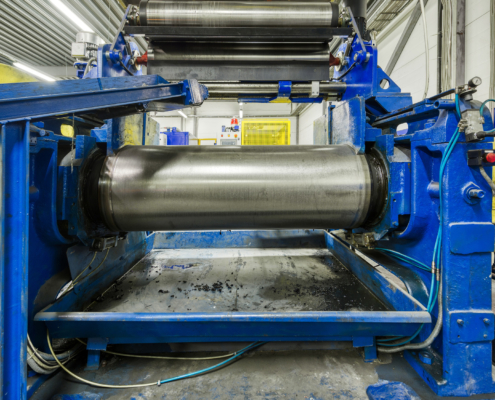
In a roller mill, the material to be processed is fed between two rollers that are set very close to each other. These rollers rotate in opposite directions or one roller may rotate while the other is stationary. As the material passes through the rollers, it is subjected to extreme pressure and shear force, which breaks it down into finer particles. The gap between the rollers can be adjusted to change the size of the final product.

Key Advantages

Roller mills excel in terms of energy efficiency. They directly apply grinding pressure to the material, which minimizes energy loss and reduces overall power consumption. This direct pressure application ensures that roller mills produce a consistent and uniform particle size, producing a high-quality final product with minimal unwanted fines. Additionally, roller mills’ durability and robust design reduce maintenance and operational costs, making any type of roller mill a cost-effective option for long-term industrial use.

Industrial Applications

In mineral processing, roller mills are invaluable for grinding hard, abrasive materials into fine particles preparing them for further processing or extraction. The cement industry also relies heavily on these mills for grinding limestone, clinker, and other components into the fine powder that becomes cement. Additionally, in the chemical production sector, roller mills are instrumental in pulverizing raw materials into fine powders that ensure uniformity and quality in end products.

Roller mills’ efficiency and control make them indispensable in industries where precise material processing is critical. Their ability to handle a variety of materials and adapt to different grinding needs while maintaining cost-effectiveness makes them an essential piece of equipment in numerous industrial settings.

Optimize Your Industrial or Mining Processes with the Right Milling Equipment

Are you not sure which milling technology is best suited for your operations? Midwest Hardfacing specializes in helping businesses like yours select the perfect mill to enhance efficiency and productivity. With our expertise in roller mills, we can guide you through the selection process, ensuring you invest in a mill that meets your specific needs and drives your success.

Consult with Our Experts

Comparative Analysis: Ball Mills vs. Roller Mills

When deciding between ball mills and roller mills, several operational and financial factors must be considered to determine which mill type best suits your specific needs. This comparative analysis delves into aspects such as efficiency, output quality, operational costs, and flexibility.

Efficiency and Energy Use

Ball mills are known for their ability to achieve fine particle sizes and handle a wide range of materials, including hard and abrasive ones. However, they typically require more energy per ton of material ground than roller mills. Roller mills stand out in energy efficiency because they apply direct pressure and shear force to the materials, which reduces energy wastage and improves grinding efficiency, which is particularly important in high-volume production settings.

Quality of Output

The quality of the milled product is paramount in many industries. Roller mills generally offer better control over particle size distribution, producing uniform particles with fewer fines. This is especially beneficial in the production of materials where particle uniformity is essential, such as in pharmaceuticals or fine chemicals. Ball mills, while capable of producing very fine powders, may produce a broader range of particle sizes, which can be an issue for processes that require great precision.

Operational Cost

Regarding operational costs, roller mills typically have a higher initial cost but lower maintenance costs over time. They are built to last and handle high-stress grinding actions, which means less wear and tear and lower replacement costs. Ball mills, while cheaper to install, may incur higher maintenance costs due to their high-speed operations and the wear associated with the constant impact of the grinding media.

Ease of Operation and Scalability

Both types of mills offer different advantages depending on their operation scales. Ball mills are easier to scale up and are thus suited for both small labs and large industrial applications. They are relatively simple to operate and maintain. Roller mills, while requiring more precise adjustments for different material types or desired outcomes, provide significant advantages in automated large-scale production environments due to their consistent and reliable output.

The choice between a ball mill vs. a roller mill should be made after considering the specific needs of your process, including the desired material characteristics, production volume, and financial constraints. Each type of mill has its strengths and weaknesses, and the right choice will depend on the particular demands of your production environment.

Choosing the Right Mill for Your Needs

When selecting from ball mills vs. roller mills, you should thoroughly evaluate your production requirements and operational objectives. The decision should align with your current needs and anticipate future expansion and scaling. Here’s how to ensure you choose the best mill for your industrial or mining operations:

Assess Material Characteristics: The physical and chemical properties of the materials you intend to process will largely dictate the suitable type of mill. Hard, abrasive materials may require the robustness of a ball mill, while materials needing precise particle sizes might benefit from the adjustability of roller mills.

Evaluate Production Volume: Consider the amount of material you need to process and at what speed. Ball mills might be preferable for operations that require flexibility in batch sizes or need to handle large quantities quickly. Conversely, roller mills could be more efficient if your focus is on continuous production with consistent results.

Consider Operational Costs: Factor in not only the initial installation and purchase costs but also long-term operational costs, including energy consumption, maintenance, and downtime. Roller mills might offer savings on energy and maintenance in the long run despite higher upfront costs.

Review Output Specifications: The desired particle size and uniformity of the final product are crucial. Roller mills generally provide greater control over particle size and a more uniform distribution, which could be critical depending on your end product’s requirements.

Think About Future Needs: Choose a mill that not only meets your current demands but can also accommodate future growth and changes in production. Flexibility in operations and ease of adjustments should be considered to adapt to new materials or altered production rates.

Choosing between a ball mill and a roller mill is a significant decision that impacts every aspect of your milling operations. By carefully considering the type of material, required particle size, operational volume, and cost constraints, you can select the mill that not only meets your immediate needs but also supports your future growth and success.

Consult with Midwest Hardfacing’s Experts

Looking for high-quality parts to repair or rebuild your roller mill? Midwest Hardfacing’s team of experts is ready to help you find the right parts to optimize your production process. With our deep industry knowledge and wide range of high-quality roller and hammer mill parts, we can help you enhance your business’s efficiency and productivity.

Share This Post

  • Share on Facebook
  • Share on X
  • Share on WhatsApp
  • Share on Pinterest
  • Share on LinkedIn
  • Share on Tumblr
  • Share on Vk
  • Share on Reddit
  • Share by Mail

More Like This

Why Your Mill Parts Fail Within One Year: Root Cause Analysis & Prevention Guide

Roller Mill Parts
https://midwesthardfacing.com/wp-content/uploads/2026/06/Why-Your-Mill-Parts-Fail-Within-One-Year.jpg 1250 2000 Abstrakt Marketing /wp-content/uploads/2024/03/Midwest-Hardfacing-1.png Abstrakt Marketing2026-06-24 07:55:462026-06-24 07:58:26Why Your Mill Parts Fail Within One Year: Root Cause Analysis & Prevention Guide
A worker inspects and sorts round parts with holes

Roller Mill Rings: Complete Buyer’s Guide to Selection & Replacement

Roller Mill Parts
https://midwesthardfacing.com/wp-content/uploads/2026/05/A-worker-inspects-and-sorts-round-parts-with-holes.jpg 1250 2000 Abstrakt Marketing /wp-content/uploads/2024/03/Midwest-Hardfacing-1.png Abstrakt Marketing2026-05-07 07:27:592026-05-07 07:28:03Roller Mill Rings: Complete Buyer’s Guide to Selection & Replacement
The Ins and Outs of Roller Mill Adjustments

How You Can Improve Milling Efficiency with Hardfaced Journals

Roller Mill Parts
https://midwesthardfacing.com/wp-content/uploads/2024/07/The-Ins-and-Outs-of-Roller-Mill-Adjustments.jpg 1250 2000 Abstrakt Marketing /wp-content/uploads/2024/03/Midwest-Hardfacing-1.png Abstrakt Marketing2025-12-09 08:47:212026-05-04 09:19:41How You Can Improve Milling Efficiency with Hardfaced Journals

What to Look for When Buying a Used Vertical Roller Mill

Roller Mill Parts, Roller Mills
https://midwesthardfacing.com/wp-content/uploads/2025/06/IMG_0577.jpeg 2048 1536 Abstrakt Marketing /wp-content/uploads/2024/03/Midwest-Hardfacing-1.png Abstrakt Marketing2025-08-11 14:27:062026-05-04 09:19:41What to Look for When Buying a Used Vertical Roller Mill
Side view of a large mine operation

Reviewing Raymond Mill Sizes: The Basics

Roller Mill Parts
https://midwesthardfacing.com/wp-content/uploads/2025/01/Side-view-of-a-large-mine-operation.jpg 1250 2000 Abstrakt Marketing /wp-content/uploads/2024/03/Midwest-Hardfacing-1.png Abstrakt Marketing2025-01-07 09:55:302026-05-04 09:19:43Reviewing Raymond Mill Sizes: The Basics
The Ins and Outs of Roller Mill Adjustments

Reviewing Key Roller Mill Parts for Bentonite Processing Plants

Roller Mill Parts
https://midwesthardfacing.com/wp-content/uploads/2024/07/The-Ins-and-Outs-of-Roller-Mill-Adjustments.jpg 1250 2000 Abstrakt Marketing /wp-content/uploads/2024/03/Midwest-Hardfacing-1.png Abstrakt Marketing2024-12-30 12:51:192026-05-04 09:19:43Reviewing Key Roller Mill Parts for Bentonite Processing Plants

The Ins and Outs Of a Roller Mill’s Structure

Roller Mill Parts
https://midwesthardfacing.com/wp-content/uploads/2024/05/Rollers-for-a-roller-mill.jpg 1250 2000 Abstrakt Marketing /wp-content/uploads/2024/03/Midwest-Hardfacing-1.png Abstrakt Marketing2024-12-30 12:44:532026-05-04 09:19:43The Ins and Outs Of a Roller Mill’s Structure

Williams Vs. Bradley Roller Mills: What You Need to Know

Roller Mill Parts
https://midwesthardfacing.com/wp-content/uploads/2024/10/Roller-mill-parts.jpg 1250 2000 Abstrakt Marketing /wp-content/uploads/2024/03/Midwest-Hardfacing-1.png Abstrakt Marketing2024-10-25 11:01:122026-05-04 09:19:43Williams Vs. Bradley Roller Mills: What You Need to Know
Closeup of rollers blanks

The Role of Roller Mill Parts in Different Industries

Roller Mill Parts
https://midwesthardfacing.com/wp-content/uploads/2024/10/Closeup-of-rollers-blanks.jpg 1250 2000 Abstrakt Marketing /wp-content/uploads/2024/03/Midwest-Hardfacing-1.png Abstrakt Marketing2024-10-25 09:30:142026-05-04 09:19:43The Role of Roller Mill Parts in Different Industries
Previous Previous Previous Next Next Next

Categories

  • Component Hardfacing
  • Downtime Reduction
  • Efficiency Optimization
  • Hammer Mill Operation
  • Hammer Mill Optimization
  • Hammer Mill Parts
  • Hammer Mill Repair
  • Hardfacing
  • Industrial Equipment Maintenance
  • Industrial Training
  • Maintenance Strategies
  • Mining
  • Preventive Maintenance
  • Roller Mill Optimization
  • Roller Mill Parts
  • Roller Mills
  • Vibration Control
  • Wear Parts
  • Workplace Safety

Contact Us

"*" indicates required fields

Who We Are

Midwest Hardfacing provides high-quality parts and services for roller and hammer mill across the world.

What We Do

Roller Mill Parts

Hammer Mill Parts

Services

Used Parts

Contact Us

205 E 4th Street / Rock Falls, IL 61071

(815) 622-9420

sales@midwesthardfacing.com

Website by Abstrakt Marketing Group ©
  • LinkedIn
  • Sitemap
  • Privacy Policy
Link to: How to Choose the Right Roller Mill for Your Industrial or Mining Needs Link to: How to Choose the Right Roller Mill for Your Industrial or Mining Needs How to Choose the Right Roller Mill for Your Industrial or Mining Needs Link to: A Deep Dive Into Hammer Mill Structure and Components Link to: A Deep Dive Into Hammer Mill Structure and Components A Deep Dive Into Hammer Mill Structure and ComponentsA Deep Dive Into Hammer Mill Structure and Components
Scroll to top Scroll to top Scroll to top

This site uses cookies. By continuing to browse the site, you are agreeing to our use of cookies.

OKLearn more

Cookie and Privacy Settings


How we use cookies

We may request cookies to be set on your device. We use cookies to let us know when you visit our websites, how you interact with us, to enrich your user experience, and to customize your relationship with our website.

Click on the different category headings to find out more. You can also change some of your preferences. Note that blocking some types of cookies may impact your experience on our websites and the services we are able to offer.

Essential Website Cookies

These cookies are strictly necessary to provide you with services available through our website and to use some of its features.

Because these cookies are strictly necessary to deliver the website, refusing them will have impact how our site functions. You always can block or delete cookies by changing your browser settings and force blocking all cookies on this website. But this will always prompt you to accept/refuse cookies when revisiting our site.

We fully respect if you want to refuse cookies but to avoid asking you again and again kindly allow us to store a cookie for that. You are free to opt out any time or opt in for other cookies to get a better experience. If you refuse cookies we will remove all set cookies in our domain.

We provide you with a list of stored cookies on your computer in our domain so you can check what we stored. Due to security reasons we are not able to show or modify cookies from other domains. You can check these in your browser security settings.

Other external services

We also use different external services like Google Webfonts, Google Maps, and external Video providers. Since these providers may collect personal data like your IP address we allow you to block them here. Please be aware that this might heavily reduce the functionality and appearance of our site. Changes will take effect once you reload the page.

Google Webfont Settings:

Google Map Settings:

Google reCaptcha Settings:

Vimeo and Youtube video embeds:

Accept settingsHide notification only