Midwest Hardfacing
  • Roller Mill Parts
    • Rings
    • Rolls
    • Journals
    • Spiders and Supports
    • Wear Parts
  • Hammer Mill Parts
    • Pins and Rods
    • Hammers
  • Services
    • Rebuilding
    • Reverse Engineering / Custom Parts
    • Consulting
  • Used Parts
    • Used Parts Inventory
  • About Us
    • Blog
    • Careers
  • Contact
  • Menu Menu

Pin Mills Vs. Hammer Mills

Pin mills and hammer mills are two of the most widely used grinding systems, each with its strengths and limitations. Understanding their differences can help you select the perfect solution for your application. Let’s dive into the key distinctions and learn when to choose a pin mill vs. a hammer mill.

What Is a Pin Mill?

Pin mills are specialized grinding machines designed to produce extremely fine powders. They use a pair of rotating discs fitted with intermeshing pins. As the material is fed into the machine, the high-speed rotation of the discs shears and impacts it, breaking it down into smaller particles. This shearing mechanism is particularly effective for achieving fine particle sizes below 100 microns.

One of the standout features of pin mills is their energy efficiency. The intermeshing pins require less energy to create finely ground materials compared to other grinding methods. Pin mills are commonly used in industries like pharmaceuticals, food processing, and chemicals, where precision and consistency are critical. They’re ideal for applications such as creating powdered spices, starch, and pigments.

What Is a Hammer Mill?

In contrast, hammer mills operate by using a series of rotating hammers to strike the material against a screen or plate. This impact crushes the material into smaller pieces, which are then sifted through the screen to achieve the desired particle size. Hammer mills are designed to handle coarser materials, making them better suited for tasks such as grain milling, biomass processing, and mineral reduction.

Hammer mills are widely appreciated for their versatility. They can process a variety of materials, including grains, minerals, and even waste products. They’re commonly used in agricultural settings for grinding animal feed or breaking down larger raw materials for further processing.

Key Differences Between Pin Mills Vs. Hammer Mills

When comparing pin mills vs. hammer mills, understanding their fundamental differences is essential to selecting the right tool for your operation. Each type of mill has its unique strengths, and choosing one depends largely on your specific application needs. Let’s explore these distinctions in greater detail.

Comparing the Grinding Mechanism

The grinding mechanism is one of the most significant differences between pin mills and hammer mills. Pin mills rely on the shearing and impact action of intermeshing pins to grind materials. This method is excellent for fine and ultra-fine grinding, as it provides precise control over particle size.

On the other hand, hammer mills use the force of impact. Rotating hammers strike the material and crush it against a screen, which dictates the final particle size. This mechanism is less suited for fine grinding but excels at reducing larger materials into manageable sizes.

Differences in Particle Size and Fineness

When it comes to achieving fine particle sizes, pin mills have the upper hand. They can grind materials down to sub-100 micron sizes with remarkable uniformity. This makes them a go-to choice for industries that require highly controlled particle sizes, such as pharmaceutical manufacturing or food production.

Hammer mills, in contrast, are more suited for coarser grinding. They’re commonly used for applications where larger particle sizes are acceptable or even preferred, such as in livestock feed or initial size reduction before further processing.

Comparisons in Energy Efficiency

Energy consumption is another key factor that sets these mills apart. Pin mills are more energy-efficient for fine grinding applications. Their shearing action requires less power to achieve smaller particle sizes, making them a cost-effective option for long-term operations.

Hammer mills, while versatile, consume more energy due to the high-impact nature of their grinding mechanism. They’re better suited for tasks that don’t require precision but demand high throughput, such as bulk material reduction.

Find Reliable Hammer Mill Parts Today

Optimize your milling processes with durable and reliable hammer mill parts. Midwest Hardfacing provides top-quality components designed to keep your equipment performing at its best.

Explore Hammer Mill Parts

Applications for Pin Mills and Hammer Mills

Pin mills and hammer mills serve distinct purposes across industries, with each machine excelling in particular applications. Identifying the right mill for your needs requires an understanding of the strengths and capabilities of each system. Here’s where these mills truly shine.

Best Uses for Pin Mills

Pin mills are specifically designed for fine and ultra-fine grinding, making them an indispensable tool in industries that demand precision. In the pharmaceutical industry, pin mills are used to produce finely ground powders for medications. They’re also prevalent in food processing, where they create powders from spices, sugar, or starch. Their ability to produce consistent particle sizes ensures that products meet strict industry standards.

Chemical manufacturers also rely on pin mills for their ability to handle fine powders, such as pigments and dyes. In these settings, even slight variations in particle size can impact product performance, making the precision of pin mills invaluable.

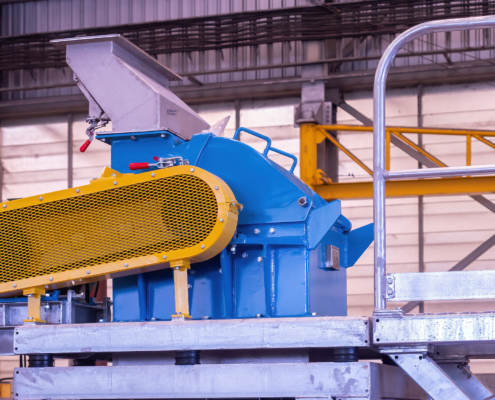
Best Uses for Hammer Mills

Hammer mills shine in applications that require high-capacity processing and coarser grinding. In agriculture, they’re used to grind grains into animal feed or crush biomass for energy production. The robustness of hammer mills makes them ideal for handling tougher materials, such as mineral ores and waste products.

In industrial settings, hammer mills are often the first step in the size reduction process. They break down large materials into smaller pieces, which can then be refined further using other grinding equipment. This makes them a versatile and essential tool in industries ranging from mining to construction.

Pin Mills Vs. Hammer Mills: Choosing the Right Tool

Selecting between a pin mill vs. a hammer mill depends on several factors, including the type of material you’re processing, the desired particle size, and your energy efficiency requirements. Pin mills are the clear choice for fine powders, offering precise particle size control and lower energy consumption. They’re ideal for industries where precision is non-negotiable.

Hammer mills, on the other hand, excel at high-capacity operations and coarser grinding. They’re the go-to solution for agricultural and industrial applications where durability and versatility are more important than achieving ultra-fine particle sizes.

Midwest Hardfacing: Your Trusted Partner for Hammer Mill Parts

When it’s time to upgrade or replace parts for your hammer mill, turn to Midwest Hardfacing for reliable solutions. With a focus on quality and longevity, we’re here to help keep your milling equipment running smoothly. Contact us today to learn more about our hammer mill parts and services!

Share This Post

  • Share on Facebook
  • Share on X
  • Share on WhatsApp
  • Share on Pinterest
  • Share on LinkedIn
  • Share on Tumblr
  • Share on Vk
  • Share on Reddit
  • Share by Mail

More Like This

When to Replace Your Hammer Mill Hammers Before Output Drops

Hammer Mill Parts
https://midwesthardfacing.com/wp-content/uploads/2025/06/Hammer-mill.jpg 1250 2000 Abstrakt Marketing /wp-content/uploads/2024/03/Midwest-Hardfacing-1.png Abstrakt Marketing2026-07-27 14:47:242026-07-27 14:47:30When to Replace Your Hammer Mill Hammers Before Output Drops
Industrial Grain Crusher Hammers Close-Up Showing Heavy-Duty Design

5 Critical Warning Signs Your Mill Parts Need Replacement (Before Failure Costs You)

Hammer Mill Parts
https://midwesthardfacing.com/wp-content/uploads/2026/05/6_Industrial-Grain-Crusher-Hammers-Close-Up-Showing-Heavy-Duty-Design.jpg 1250 2000 Nate Riggins /wp-content/uploads/2024/03/Midwest-Hardfacing-1.png Nate Riggins2026-05-04 15:51:092026-05-04 15:51:175 Critical Warning Signs Your Mill Parts Need Replacement (Before Failure Costs You)
rotary longitudinal blade of universal crusher fine grinder machine for vegetable foodstuff_

Hammer Mill Replacement Parts: Complete Selection & Sourcing Guide

Hammer Mill Parts
https://midwesthardfacing.com/wp-content/uploads/2026/05/5_rotary-longitudinal-blade-of-universal-crusher-fine-grinder-machine-for-vegetable-foodstuff_.jpg 1250 2000 Nate Riggins /wp-content/uploads/2024/03/Midwest-Hardfacing-1.png Nate Riggins2026-05-04 15:39:142026-05-04 15:39:20Hammer Mill Replacement Parts: Complete Selection & Sourcing Guide
Stainless steel pipe, flange and bolts

Understanding Hammer Mill Part Wear and Tear

Hammer Mill Parts
https://midwesthardfacing.com/wp-content/uploads/2025/07/Stainless-steel-pipe-flange-and-bolts.jpg 1250 2000 Abstrakt Marketing /wp-content/uploads/2024/03/Midwest-Hardfacing-1.png Abstrakt Marketing2025-07-02 10:52:042026-05-04 09:19:41Understanding Hammer Mill Part Wear and Tear

Hammer Mill Hammers for Feed, Grain, and Biomass: What’s the Difference?

Hammer Mill Parts
https://midwesthardfacing.com/wp-content/uploads/2025/06/Hammer-mill.jpg 1250 2000 Abstrakt Marketing /wp-content/uploads/2024/03/Midwest-Hardfacing-1.png Abstrakt Marketing2025-06-18 14:58:342026-05-04 09:19:42Hammer Mill Hammers for Feed, Grain, and Biomass: What’s the Difference?
Rock crushing equipment in quarry

The Benefits of Hardfacing for Barite Grinding

Hammer Mill Parts, Hardfacing
https://midwesthardfacing.com/wp-content/uploads/2025/02/Rock-crushing-equipment-in-quarry.jpg 1250 2000 Abstrakt Marketing /wp-content/uploads/2024/03/Midwest-Hardfacing-1.png Abstrakt Marketing2025-02-19 12:31:582026-05-04 09:19:42The Benefits of Hardfacing for Barite Grinding
A group of roller mill parts

A Guide to Different Hammer Mill Parts

Hammer Mill Parts
https://midwesthardfacing.com/wp-content/uploads/2024/05/A-group-of-roller-mill-parts.jpg 1250 2000 Abstrakt Marketing /wp-content/uploads/2024/03/Midwest-Hardfacing-1.png Abstrakt Marketing2024-09-30 15:39:142026-05-04 09:19:43A Guide to Different Hammer Mill Parts
A Deep Dive Into Hammer Mill Structure and Components

A Deep Dive Into Hammer Mill Structure and Components

Hammer Mill Parts
https://midwesthardfacing.com/wp-content/uploads/2024/09/A-Deep-Dive-Into-Hammer-Mill-Structure-and-Components.jpg 1250 2000 Abstrakt Marketing /wp-content/uploads/2024/03/Midwest-Hardfacing-1.png Abstrakt Marketing2024-09-25 07:56:352026-05-04 09:19:43A Deep Dive Into Hammer Mill Structure and Components
Previous Previous Previous Next Next Next

Categories

  • Component Hardfacing
  • Downtime Reduction
  • Efficiency Optimization
  • Hammer Mill Operation
  • Hammer Mill Optimization
  • Hammer Mill Parts
  • Hammer Mill Repair
  • Hardfacing
  • Industrial Equipment Maintenance
  • Industrial Training
  • Maintenance Strategies
  • Mining
  • Preventive Maintenance
  • Roller Mill Optimization
  • Roller Mill Parts
  • Roller Mills
  • Vibration Control
  • Wear Parts
  • Workplace Safety

Contact Us

"*" indicates required fields

Who We Are

Midwest Hardfacing provides high-quality parts and services for roller and hammer mill across the world.

What We Do

Roller Mill Parts

Hammer Mill Parts

Services

Used Parts

Contact Us

205 E 4th Street / Rock Falls, IL 61071

(815) 622-9420

sales@midwesthardfacing.com

Website by Abstrakt Marketing Group ©
  • LinkedIn
  • Sitemap
  • Privacy Policy
Link to: Reviewing Raymond Mill Sizes: The Basics Link to: Reviewing Raymond Mill Sizes: The Basics Reviewing Raymond Mill Sizes: The BasicsSide view of a large mine operation Link to: The Benefits of Hardfacing for Barite Grinding Link to: The Benefits of Hardfacing for Barite Grinding Rock crushing equipment in quarryThe Benefits of Hardfacing for Barite Grinding
Scroll to top Scroll to top Scroll to top

This site uses cookies. By continuing to browse the site, you are agreeing to our use of cookies.

OKLearn more

Cookie and Privacy Settings


How we use cookies

We may request cookies to be set on your device. We use cookies to let us know when you visit our websites, how you interact with us, to enrich your user experience, and to customize your relationship with our website.

Click on the different category headings to find out more. You can also change some of your preferences. Note that blocking some types of cookies may impact your experience on our websites and the services we are able to offer.

Essential Website Cookies

These cookies are strictly necessary to provide you with services available through our website and to use some of its features.

Because these cookies are strictly necessary to deliver the website, refusing them will have impact how our site functions. You always can block or delete cookies by changing your browser settings and force blocking all cookies on this website. But this will always prompt you to accept/refuse cookies when revisiting our site.

We fully respect if you want to refuse cookies but to avoid asking you again and again kindly allow us to store a cookie for that. You are free to opt out any time or opt in for other cookies to get a better experience. If you refuse cookies we will remove all set cookies in our domain.

We provide you with a list of stored cookies on your computer in our domain so you can check what we stored. Due to security reasons we are not able to show or modify cookies from other domains. You can check these in your browser security settings.

Other external services

We also use different external services like Google Webfonts, Google Maps, and external Video providers. Since these providers may collect personal data like your IP address we allow you to block them here. Please be aware that this might heavily reduce the functionality and appearance of our site. Changes will take effect once you reload the page.

Google Webfont Settings:

Google Map Settings:

Google reCaptcha Settings:

Vimeo and Youtube video embeds:

Accept settingsHide notification only